
The design is what people fall in love with in a piece of marble inlay, the flowers, vines, and patterns that seem to grow out of the stone. Marble inlay design has a rich vocabulary built over four centuries, from Mughal florals to clean modern geometry, and because every piece is made to order, that vocabulary can be adapted to almost any room. This guide covers the main marble inlay design motifs, how they are used on floors, tables, and walls, how the stones shape a design, and how to commission something bespoke.
How marble inlay design works
In marble inlay, or pietra dura, a design is drawn to scale, and every element, every petal, leaf, and line, is cut from coloured stone and set flush into a marble base. This means a design is not limited to what a mould or a tile can print: it can be as fine and naturalistic as a painting. The art lies in choosing motifs and colours that suit the piece and the room, and in the hand-work that fits hundreds of cut stones together seamlessly. For the craft behind it, see our guide to pietra dura.
Popular marble inlay design motifs
Most marble inlay designs draw on a handful of motif families, often combined in one piece:
Floral and Mughal designs
The floral vine is the signature of Indian marble inlay, perfected under the Mughals and seen on the Taj Mahal. Designs range from a single blossom to trailing vines, bouquets in a vase, and dense all-over floral fields. Mughal florals use naturalistic flowers, poppies, lilies, irises, in graded semi-precious stones, and remain the most popular choice for table tops and wall panels.
Geometric and border designs
Geometric inlay uses stars, rosettes, interlacing bands, and repeating tessellations, a tradition drawn from Islamic art. Geometric medallions anchor floors and table centres, while geometric borders frame a plain field cleanly. Because they rely on line and symmetry rather than dense colour, geometric and border designs often read as more modern and can be done in as few as two stones.
Peacocks, trees of life and figurative designs
Beyond flowers and geometry, marble inlay carries figurative motifs: the peacock, the tree of life (a flowering tree rising from a base, often with birds), elephants, and paisley. These make striking centrepieces for wall panels and statement table tops, and they show off the craft's ability to render fine detail in stone.

Designs for floors, tables and walls
The same motifs are scaled to the piece:
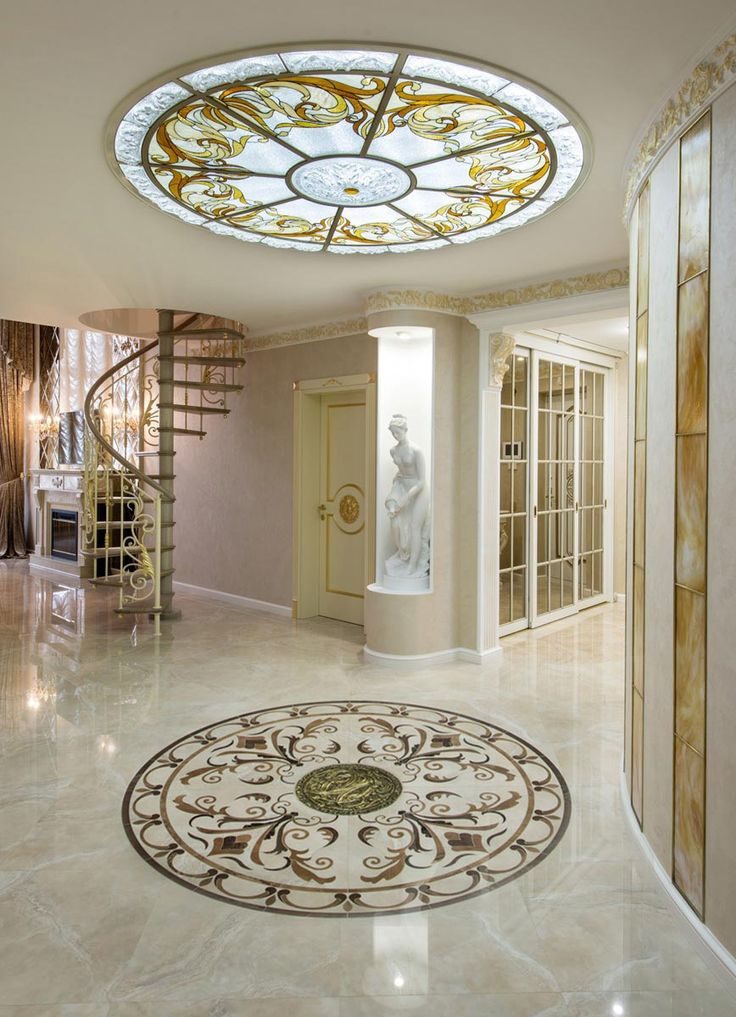
- Floors — central medallions, borders, and full-floor mandalas. See our marble floor designs guide.
- Table tops — a central floral or geometric motif with a border, sized to dining, coffee, and centre tables.
- Wall panels — framed florals, trees of life, and calligraphy as art for a feature wall or a mandir backdrop, see our wall panels.
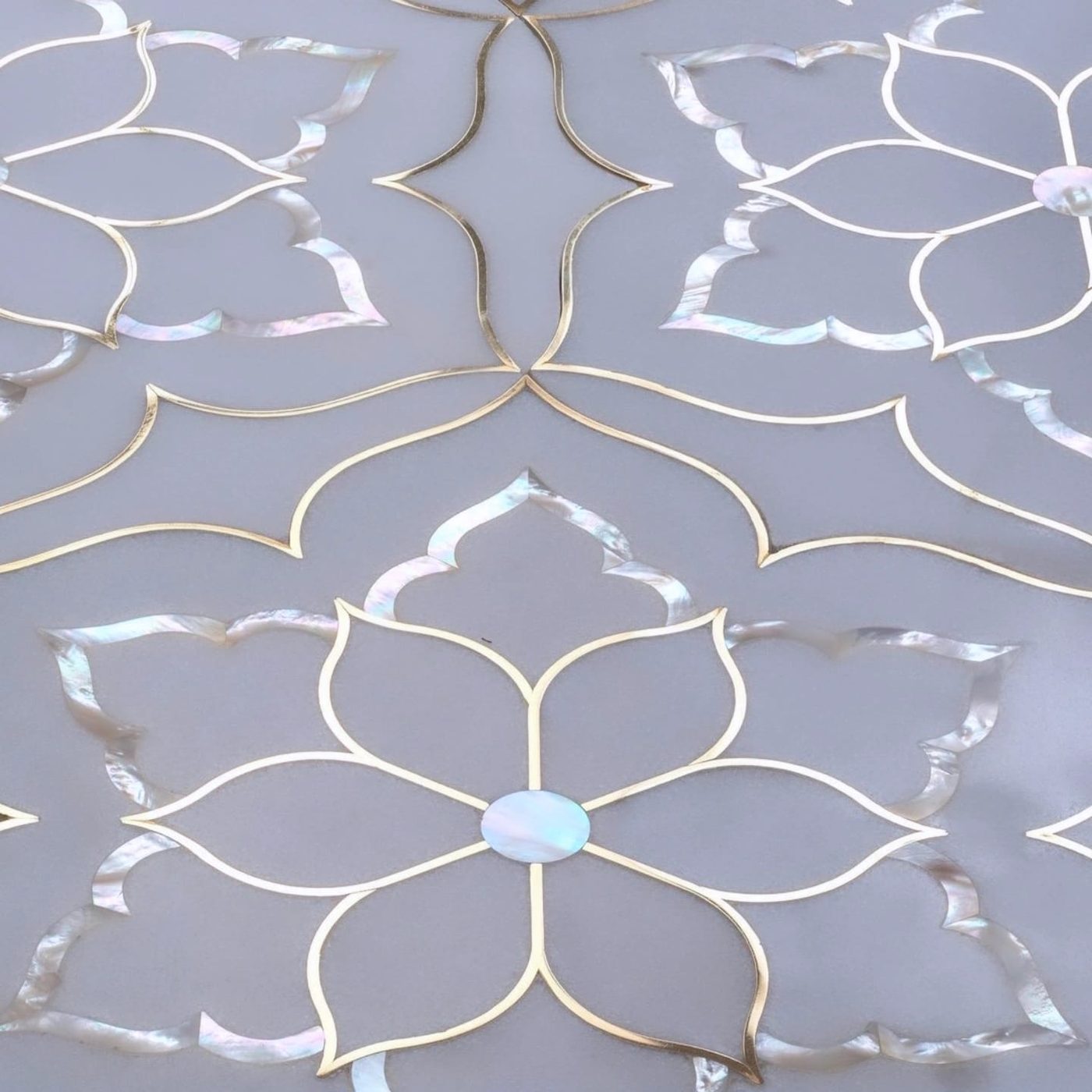
- Accents — brass line inlay, Paua shell highlights, and mosaic fields for texture.
How stones shape a design
The palette comes from natural stone: lapis lazuli for deep blue, malachite for green, carnelian for orange-red, jasper and agate for earthy tones, turquoise, and mother-of-pearl for iridescent whites. Brass is used for the finest lines. Because the colour is the stone itself, it never fades, and part of designing a piece is choosing stones whose colours suit the room and sit well against the white or black marble base.
Marble inlay vs mosaic designs
People often ask whether marble inlay is a kind of mosaic. They are related but different crafts. A mosaic builds an image from many small, similar tiles with visible grout between them; marble inlay cuts each stone to the exact shape of the element it represents and sets it flush with no grout. The result is that mosaic reads as a grid of pieces, while inlay reads as a smooth, continuous picture in stone. Both have their place, and we make both.
Custom and bespoke marble inlay designs
Because every piece is made to order, the design is yours to shape: we can work from your sketch, adapt a traditional motif to your colours, scale a pattern to your space, or design something entirely new, and we draw it to scale for your approval before any stone is cut. We handcraft marble inlay in Udaipur and deliver across India and worldwide. Browse our crafts, see how inlay is priced, or tell us your idea.
Frequently asked questions
What are the most popular marble inlay designs?
Floral and Mughal vines are the most requested, followed by geometric medallions and borders, and figurative motifs such as peacocks and the tree of life. A central floral medallion framed by a border is the classic composition.
What is the difference between marble inlay and mosaic?
Mosaic builds an image from many small, similar tiles with visible grout. Marble inlay (pietra dura) cuts each stone to the exact shape it represents and sets it flush with no grout, so the surface is smooth and reads like a painting in stone.
What stones are used in marble inlay designs?
Semi-precious stones such as lapis lazuli, malachite, carnelian, jasper, agate, turquoise, and mother-of-pearl, plus brass for fine lines, set into white Makrana or black marble.
Can I get a custom marble inlay design?
Yes. Every piece is made to order, so we can work from your drawing, match a colour scheme, adapt a traditional motif, or design something new, then draw it to scale before any stone is cut.
Which marble inlay design suits a modern interior?
Simple geometric borders, a single-colour motif, or fine brass line inlay on white marble read as contemporary, while dense multi-stone florals suit traditional interiors.
Do the colours in marble inlay fade?
No. The colour comes from natural stone, not dye or paint, so an inlaid design keeps its colour for generations.
Bring your idea to life.
Tell us your space, design, and size. We will plan it with you and make it by hand.
Enquire now